What closed in the Mississippi Delta, and who stayed
Four of these five towns have lost between a third and a half of their people
since 1980. What is striking in the film about them is not who left. It is how many of the
people still there say they would not go anywhere else.
Nilfpay · 20 August 2026 · updated 21 August
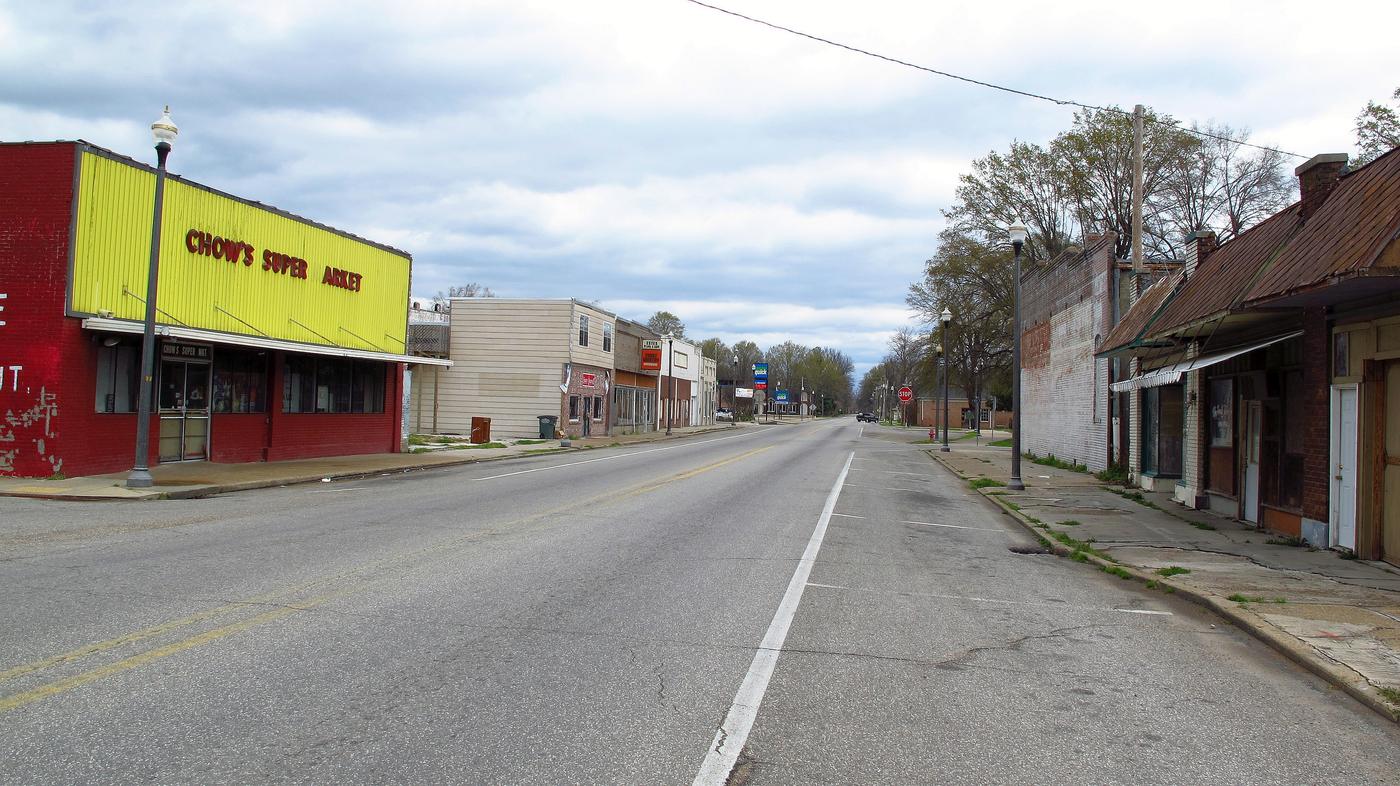
Main Street in Rosedale, Mississippi. The grocery on the left is open; most of
the row opposite is not.
Photo by Magnolia677,
CC BY 4.0.
The film is RocaNews's. Max Frost and his crew spent days driving the Delta and
published "Inside Mississippi's Rural Hoods", with a
written companion on 28 January 2026. Every scene
described here is theirs, and it is worth your sixteen minutes. What follows is the part a
few days of driving cannot carry: what the census, the CDC, the FDIC and the USDA say about
how these towns got this way, and what the people in them say about why they stay.
The easy version of this story is the shooting. On 10 October 2025 seven people were killed
at Fourth and North Main in Leland, a town of 3,988, in the deadliest mass shooting in the
United States last year, and the country had stopped talking about it inside a week.
The more useful version is the one the film keeps returning to without ever quite saying it
out loud: hardly anybody in it wants to leave. A woman who has spent sixteen years caring for
an elderly employer offers to drive the crew to her own town so they can see it properly. A
man in Jonestown says plainly that he could go and does not want to. A former Marine came
home to the town with the worst nickname in the Delta and now runs the group that cleans it.
A dancer who has worked in Japan, Italy, India and South Korea came back to a town of 1,584
people.
So the numbers below are here to explain what these towns lost, not to explain away the
people who stayed. The census counted these places in 1980 and again in 2020. The CDC records
where people are killed. The FDIC records where the banks went. The USDA has kept a list, for
thirty years, of the counties that never stopped being poor. None of that accounts for a
specific night on a specific street. All of it describes the conditions the people in this
film are choosing to live in anyway.
"It's a good place. It's a good place. We ain't got no restaurants. If we had
some stoves or something to go to, this place be greater than what it is."
Jonestown, in the RocaNews film
Start with the arithmetic that every other number here follows from. These are decennial
census counts, not estimates: the town in 1980, the same town in 2020.
Friars Point
Coahoma County
1,400 in 1980 → 896 in
2020 down 36%
A river town that used to be a county seat and stopped being one by 1930, when the business of Coahoma County moved to Clarksdale for good. When Time went there in 2013 it counted what was left: an elementary school, a few churches, a city hall, a post office and a small general store. No doctor and no clinic, no drugstore, no library, no sit down restaurant, and in the magazine's words no businesses to speak of. The crew drove in expecting an old southern town and filmed empty buildings on a street with antebellum houses still standing on it. What is open is a filling station and store that a family has run since 1995, where the man behind the counter is a sharecropper's son who moved to California and came back, and where he says his father was shot inside it and that no amount of paint covers where the blood is.
Jonestown
Coahoma County
1,231 in 1980 → 962 in
2020 down 22% Peak 1,701 in 2000, so down 43% from its peak
The men outside the shop say the mill was the backbone of the town and that one of them gave it thirty years. Delta Oil Mill had crushed cottonseed in Jonestown since 1942. In October 2014 its president said out loud what the acreage already implied, that there was not enough cottonseed left to justify running two plants: Coahoma County had planted 140,000 acres of cotton in 2006 and was down to 50,000 or 60,000, with the rest of the land turned over to rice, soybeans, corn and peanuts. The company went through bankruptcy and the plant closed. It is the one thing here that came back. The site reopened as Cottonseed Co-op, incorporated in 2015, and when its workers unionised in June 2020 there were 57 of them. A town of 962 people got its factory back at the size a town of 962 people gets.
Mound Bayou
Bolivar County
2,917 in 1980 → 1,534 in
2020 down 47%
Founded on 12 July 1887 by Isaiah T. Montgomery and Benjamin T. Green, who bought swampland and built a town that freed slaves and their children would own and govern themselves. It incorporated in 1898. This is the place the crew set out to find, and the thing worth knowing about its decline is when it happened: the census counted more people in Mound Bayou in 1980 than in any year before it. The town's high water mark is inside living memory, and 47% of it has left since. It was still 96.8% Black at the 2020 census.
Rosedale
Bolivar County
2,793 in 1980 → 1,584 in
2020 down 43%
The town the film keeps coming back to, and the one with a nickname it does not want. In 2010 Rosedale had the twenty second lowest median household income of any place in the United States with more than a thousand residents. What the camera finds on the main street is a row of clubs, a blue building that one of them thinks is going to be a hookah lounge, and men who answer the question about daily life with a joke about getting shot and then, a beat later, with "good living, it's cool, it's laid back." Both answers are the town. The person the piece ends on is a former Marine who came home, mentors kids and organises the group picking up litter in it.
Leland
Washington County
6,667 in 1980 → 3,988 in
2020 down 40%
On the night of 10 October 2025 a homecoming crowd was on North Main Street at Fourth. Seven people were killed and nineteen were injured, twelve of them by gunfire. It was the deadliest mass shooting in the United States in 2025. Nine people were arrested, the Mississippi Bureau of Investigation led the case with the FBI, which set up a tip line for phone footage and put up a $5,000 reward. The town has 3,988 residents. The film's point about it is not the arithmetic of the night but how quickly the country stopped talking about it, and that part is hard to argue with.
The people who stay
Ask what daily life is like in Rosedale and the first answer is a joke about getting shot.
The second answer, a beat later from the same men, is "good living life, it's cool, it's a
laid back, small town." Both are true at once, and only one of them ever leaves the county.
The town's nickname is the RIP. The men who explained what it stands for also said they
refuse to use it: "we don't like to uphold that name. This is our city. It's a place of
love."
In Jonestown two men outside the shop run through what the town has lost, the mill and the
four banks and the restaurants, and then land somewhere else entirely: "it's a good place.
It's a good place. That's all we got. That's all I love. All I love. But I can leave. I don't
want to leave." What they offer a stranger who turns up with a camera is this: "you come here
with open arms, we treat you like our brother."
In the town the crew were driven to, a woman who was born and raised there and has spent
sixteen years caring for an elderly employer sums up four decades in a sentence: "I learned
to live with it and deal with it. I won't change it for nothing." Then: "we're mostly family
here. Everybody."
At the filling station, the sharecropper's son who moved to California and came back is
not sentimental about either place. He loved Los Angeles enough to change his name over it.
He still says this: "if you don't come to Mississippi, you won't know what the South is
about." And he says the thing that is easy to miss, which is that leaving and returning is
now a route rather than a defeat: "a lot of people can go to California and come back with
new ideas."
Then there is the man the film ends on. He left for the Marine Corps, joined a dance team
while stationed in Japan, became a pioneer of a dance style, worked in Italy, India and South
Korea, built an audience of 32,000, and came home to Rosedale. He mentors kids, picks up
litter with whoever turns up, and describes the job in the plainest possible terms: "be a
product of our community, be proactive instead of reactive." His theory of how a place
changes has no policy in it at all: "each one teach one, then it's going to catch on like a
fire."
That is the Delta the numbers cannot reach. The people in this film are not stuck there in
the way the phrase usually means. Many of them have seen elsewhere, some of them have lived
elsewhere, and they came back to a county with a third of its people gone and no bank in
town, because it is theirs.
What the numbers say
Poverty is not a bad year here, it is the baseline
The USDA keeps a category called persistent poverty: a county whose poverty rate has sat at
or above 20% at four measurements taken roughly ten years apart, which is to say for about
three decades without a break. In the 2025 edition of its county typology, 318 counties in
the United States qualify, around one in ten. Forty four of them are in Mississippi, out of
eighty two counties in the state.
County
Towns here
Population
Median household income
Poverty rate
Bolivar County
Rosedale, Mound Bayou
29,534
$39,585
32.6%
Coahoma County
Friars Point, Jonestown
20,540
$37,461
35.5%
Washington County
Leland, Greenville
42,765
$42,165
26.5%
Mississippi
$56,447
18.9%
United States
$80,734
12.5%
American Community Survey 2024 five year estimates. A household in Coahoma
County takes home less than half of the national median, and better than one person in three
is below the poverty line.
The violence is rural, and it is measured
The film's framing is that the country only talks about Memphis and Jackson. The data
agrees with it. Analysis of CDC mortality records by the Center for American Progress puts
the highest gun homicide rates in the country not in the big cities but in rural counties,
and over 2021 to 2024 eight of the twenty highest rates in the United States were Mississippi
counties, five of them in the top ten. Holmes County had the highest per capita firearm
homicide rate of any county in the nation in 2024.
County
Gun homicides per 100,000, 2021 to 2024
St. Louis, Missouri
independent city, counted as a county
77.94
Washington County, Mississippi
Leland, Greenville
68.60
Holmes County, Mississippi
highest in the country in 2024 alone
67.48
Hinds County, Mississippi
Jackson
67.22
Leflore County, Mississippi
Greenwood, Itta Bena
66.90
Coahoma County, Mississippi
Clarksdale, Friars Point, Jonestown
53.47
Washington County, where Leland is, sits second in the country, behind only
St. Louis. Bolivar County, which holds Rosedale and Mound Bayou, is not in the top twenty.
In the film the man from Rosedale lists the response: Cleveland on a curfew, Greenville on
a curfew. Both are real. Greenville's council imposed a citywide 9pm to 6am curfew in 2025
after a college footballer from the town was shot dead, with nightclubs ordered shut by
midnight, and Cleveland requires late night businesses in its commercial districts to close
from midnight until 5am. None of that is why the towns emptied out: the
population figures above were most of the way down before any of this, and the mill and the
banks went first. Violence is what happens to a place that has already lost its work, and
almost everyone in the film says the same thing about it, that it is the young and it is the
guns and it was not like this before.
Two corrections to the film, because they are ours to make.
It says 26 people were shot in Leland. Seven were killed and nineteen were injured,
twelve of them by gunfire, so 26 is the number of people hurt and 19 is the number shot.
It also says three of America's five highest murder rate counties are in rural
Mississippi. We could not source that sentence in that form. The version above is
sourceable, and it is worse.
The banks left, and that is measurable too
In Jonestown the men outside the shop say they used to have four banks and now have none.
We cannot verify the four. We can verify the pattern it belongs to: the National Community
Reinvestment Coalition counted 6,008 places in the United States where banks closed branches
between 2008 and 2016, and in the Federal Reserve's sixth district, which includes
Mississippi, 46% of rural counties lost branches between 2012 and 2017 against 41% of rural
counties nationally. When Regions Bank decided several Delta branches no longer made sense,
four of them were handed to Hope Credit Union in 2015. Itta Bena, forty miles from Leland,
ended up with no bank at all.
A rural census tract counts as a banking desert when there is no branch within ten miles.
That distance is not an inconvenience, it is a credit condition: the further a small
business sits from a lender, the less likely the lending is to happen.
And the cotton went first
The film says sharecropping ended in the 1960s. It declined with mechanisation from the
1940s on, and the acreage tells the story better than a decade does. Coahoma County planted
140,000 acres of cotton in 2006. Within a few years it was down to 50,000 or 60,000, the land
switched to rice, soybeans, corn and peanuts, and in October 2014 the president of Delta Oil
Mill said there was no longer enough cottonseed in the region to justify running both of his
plants. The mill in Jonestown had been crushing seed since 1942. That is the sequence in one
county: the crop changes, the mill that existed to process the crop closes, and the town that
existed to staff the mill has 962 people left in it.
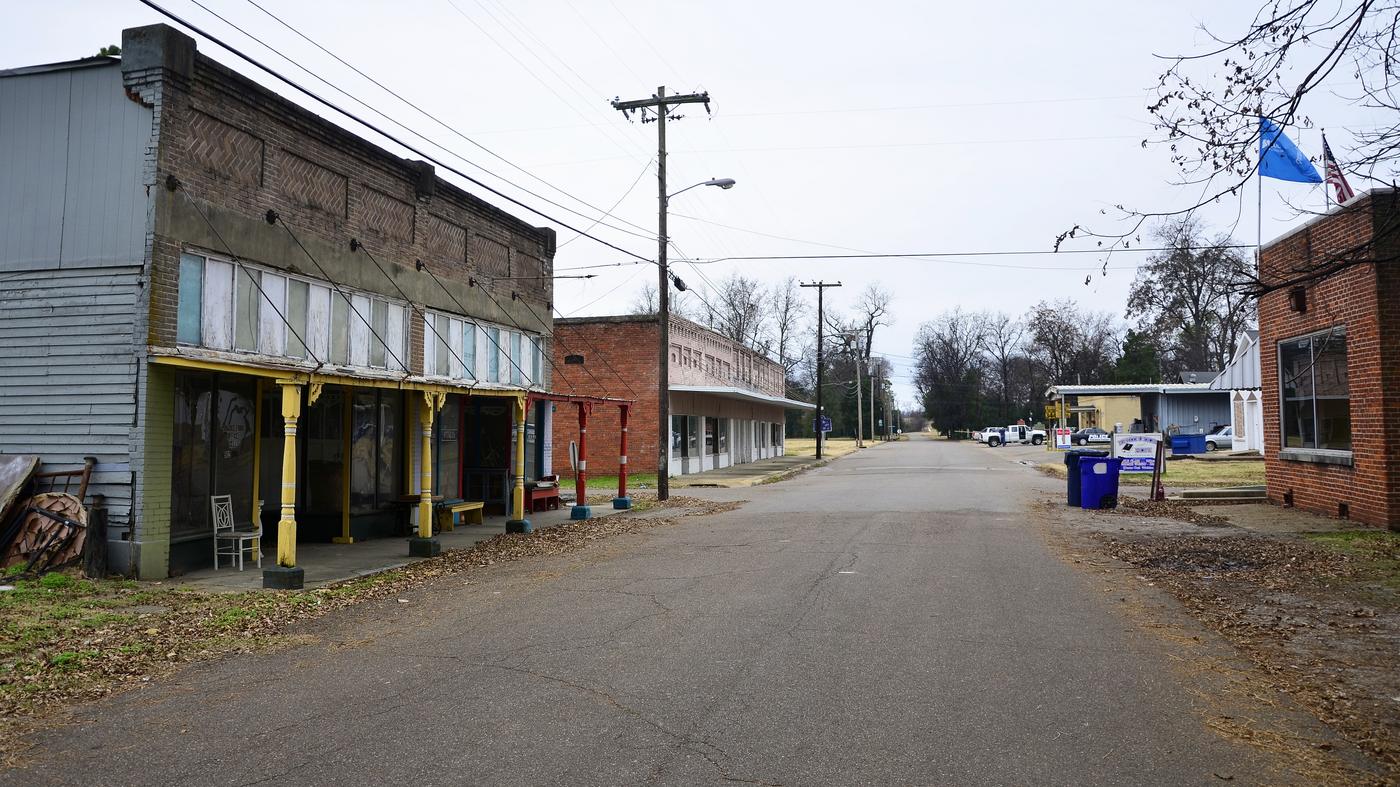
Friars Point. When Time counted the town's businesses in 2013 it found a general
store and not much else.
Photo by Magnolia677,
CC BY-SA 4.0.
What is still open is somebody's hustle
Watch the film for what people are actually doing for money and the same shape keeps
turning up. A filling station in Friars Point that a family has run since 1995, selling pig
feet, pork salad and Stage Planks, the iced molasses cookies sold in the South since before
1901 and which the auto captions turn into "state planes". A dancer with an international
career and an audience of 32,000, home and working. A man who spent thirty years at the mill
and is still the person who knows how the town works. And two men naming, unprompted, the
business their town is missing: "we ain't got no restaurants. If we had some stoves or
something to go to, this place be greater than what it is."
That last line is the whole thing. It is not a complaint about the government or a wish for
a factory to come back. It is a man saying his town would be better if somebody cooked, and
the reason nobody has is not that nobody there can cook.
What left these towns was the premises. The mill, the four banks, the sit down restaurant,
the drugstore, the businesses Time went looking for in Friars Point and could not find. What
is still standing is people trading without any of it: out of a kitchen, out of a truck, out
of a phone, out of a station that has been in one family for thirty years. That is not a
consolation prize. It is how most commerce in America started and it is how a place with no
landlord, no bank branch and no card machine still has an economy.
It is also, exactly, who this company is for. Nilfpay exists because somebody who makes
something good should not need a shopfront, a card terminal or a bank in town to sell it. The
people in this film already do the hard part, which is being the kind of person who stays and
builds something anyway. The part we can take off them is smaller and duller: a page that
takes the order, states the price and gets them paid before they cook.
What we are doing, and what is in it for us
Two things we are doing about it that cost us something, and one honest note: a page
like this gets us read, and we would rather say so than pretend otherwise.
Delta towns go into the directory. Anyone selling in these counties gets a page
on nilfpay.com/shops that they can claim and control, free,
whether or not they ever heard of us. That is how the rest of the directory was built and
there is no reason these towns should be last.
We will build the shop for you, on a call, free. If you sell something you make
in any of the forty four Mississippi counties on the USDA's persistent poverty list, or
anywhere like them, email [email protected]
and we will do the photos, the catalogue and the link with you while you are on the
phone. Sellers keep 100% of the price. Our fee is 4% and the buyer pays it.
We are not claiming a payment link fixes a town that lost its cotton in the
2000s and its mill after it. It does not. It removes one specific obstacle, which is needing
a shop, a card machine or a bank in town in order to sell what you make. The people in this
film have already done the harder part.
The deadliest shooting of 2025 happened in a town of 4,000 people and you probably did not hear about it.
Town populations are decennial census counts. County income and poverty are ACS 2024 five
year estimates. Gun homicide rates are annualised 2021 to 2024. Where a claim in the film
could not be sourced, this page says so instead of repeating it. Corrections to
[email protected] and we will fix them here.
.jpg)
.jpg)